Statement
“We live […] in a mesh of interwoven lines, where the lines of life, growth, and movement become entangled.” (Ingold, 2011, p. 63)
My artistic practice emerges from a concern with how we inhabit the planet and the distance between sustainability discourse and the actions that shape our relationship with natural systems. In response to an extractive model that understands nature as a resource, I explore forms of coexistence based on interdependence and regeneration. In this pursuit, I engage with Anna Tsing’s understanding of the world as a network of interdependencies between humans and other forms of life. From this perspective, artistic experience becomes a space for reconfiguring our perception of these relationships; I am not interested in illustrating collapse, but in training the imagination to recognize that other forms of coexistence are possible.
My work takes the form of objects, installations, and 2D compositions that function as material testimonies of other ways of inhabiting the world. Rather than representing futures, I seek to create conditions for imagining regenerative relationships between humans, ecosystems, and matter. My works operate as devices for observing the present from viable futures, shifting away from Anthropocene narratives centered on crisis toward scenarios of collaboration. Here, I find an affinity with Julian Bleecker’s understanding of objects as mediators between imagination, knowledge, and experience.
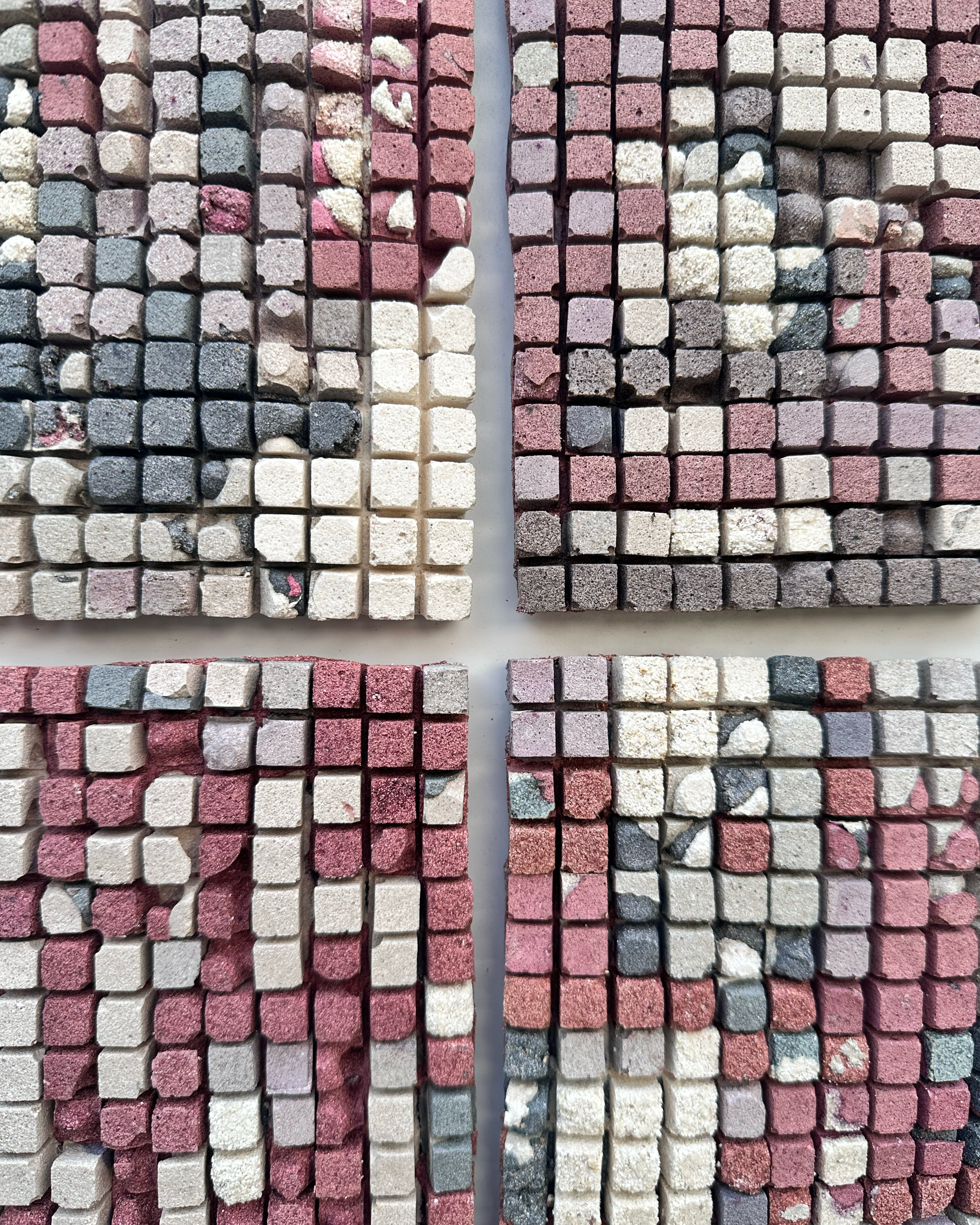
My practice investigates forms of coexistence that take shape across different bodies of work. One of these investigations develops through the series Devices for Trajectories into the Future (2025–), where sculptures and installations constructed from bioceramic modules joined by thread and cotton fabric explore relationships between fragility, resilience, and transformation.
I work with biomaterials such as eggshell bioceramics, cotton thread, and natural pigments, which can safely return to biological cycles. Their selection responds to their physical qualities, my interest in circular economy, and an understanding of matter, informed by Jane Bennett’s new materialism, as an active participant in the production of meaning rather than an inert support. In this way, matter becomes a means of exploring new interspecies relationships.